
Microsoft's work-trend research shows that meeting load did not snap back after the first remote-work surge. By 2023, people were in nearly three times as many Teams meetings and calls per week as they were in February 2020. The calendar became the default place companies tried to recreate office context.
That should stop you. The response from most companies has been... more meetings. Standups to align. Syncs to sync. Pre-meetings to prepare for the real meetings. Retros to discuss what went wrong in the last round of meetings.
The instinct makes sense. When you can't walk over to someone's desk, a meeting feels like the safest replacement. But it's the wrong replacement. Remote teams don't suffer from a lack of synchronous time together. They suffer from a lack of shared context. And those are fundamentally different problems with fundamentally different solutions.
The Context Gap
In a physical office, shared context happens passively. You overhear a conversation about a project shift. You notice that a colleague looks stressed. You catch a quick update in the hallway between meetings. You see the whiteboard in the conference room and get a sense of where a project stands. None of this requires a calendar invite.
Remote work eliminated all of it. And instead of replacing that passive context flow with new systems, most teams defaulted to the only tool they knew: scheduling a call. The meeting became the universal solvent for uncertainty. Don't know what someone's working on? Schedule a standup. Unclear on priorities? Schedule an alignment call. Need a decision? Schedule a meeting to discuss.
The result is a workforce spending more time talking about work instead of doing it. And the meetings themselves often fail to solve the underlying problem, because sharing context in real-time via video is one of the least efficient ways to transfer information. You're constrained by the slowest speaker, the longest tangent, and the worst connection.
Why Meetings Are the Wrong Fix
Meetings solve a narrow category of problems well: real-time brainstorming, emotionally sensitive conversations, complex negotiations, and relationship building. For everything else, they're overkill.
Most daily meetings exist because someone on the team is anxious about alignment, and a standing meeting feels like insurance. But the cost is real. In distributed teams, those "quick syncs" often land outside someone's local business hours. They're eating into personal time, compounding fatigue, and creating resentment.
The data on Zoom fatigue is also revealing. Stanford's Virtual Human Interaction Lab identified four mechanisms behind video-call exhaustion, including excessive close-up eye contact, self-view, reduced mobility, and higher cognitive load for nonverbal cues. The meeting-heavy approach to remote work isn't just inefficient. It systematically disadvantages people who pay the highest attention tax in those rooms.
Shared Context: The Alternative
Shared context means everyone on the team has access to the same foundational information without needing to be in the same room at the same time. It's the asynchronous equivalent of the office hallway, the overheard conversation, the whiteboard on the wall.
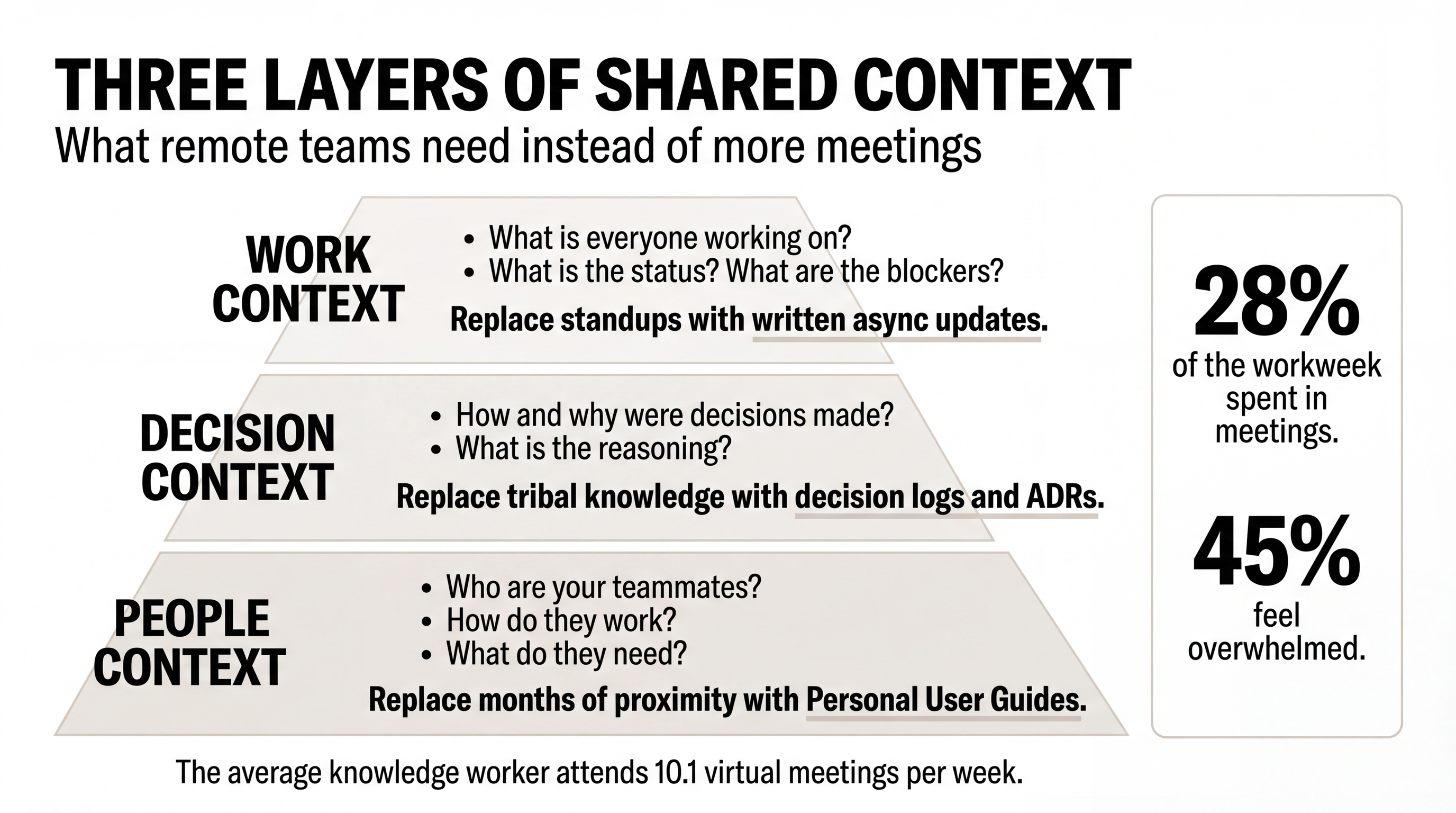
Building shared context requires three layers:
Layer 1: Work context. What is everyone working on, what's the status, and what are the blockers? This is what most standups try to capture, but a well-maintained project board or written async standup does it better. When a team member can post a three-sentence written update ("Shipped the auth redesign to staging. Waiting on QA. Blocked on the API team for endpoint documentation."), everyone gets the information in 15 seconds instead of a 30-minute call.
Layer 2: Decision context. How and why were decisions made? This is where most remote teams hemorrhage alignment. Someone misses a meeting, and the decision that was made becomes tribal knowledge. A new team member joins and has no idea why the architecture looks the way it does. Decision logs, architectural decision records (ADRs), and meeting summary docs create a paper trail that any team member can access at any time.
Layer 3: People context. Who are your teammates, how do they work, and what do they need? This is the hardest layer to build remotely, and the one most companies ignore entirely. In an office, you develop a mental model of your colleagues over months of proximity. Remote teams don't get that luxury. The hidden context is how a colleague communicates, decides, handles stress, and interprets urgency.
This third layer is where Personal User Guides earn their place. A PUG gives every team member a readable guide to working with every other team member. Communication preferences, feedback style, stress signals, decision-making approach. The kind of information you'd normally absorb through months of working side by side, compressed into a document you can read in five minutes.
The Async-First Playbook
Shifting from meeting-heavy to context-rich doesn't mean eliminating meetings. It means being intentional about when synchronous time is actually necessary. Here's a practical framework.
Default to async. Status updates, routine decisions, information sharing, and non-urgent questions should all happen asynchronously. Written standups, recorded Loom walkthroughs, Slack threads with clear deadlines for responses. The bar for scheduling a meeting should be: "Can this be resolved in writing?" If the answer is yes, don't meet.
Protect synchronous time for what it does best. Brainstorming sessions, difficult conversations, team building, and complex problem-solving all benefit from real-time interaction. When you reduce the volume of unnecessary meetings, the ones that remain become higher quality because people aren't showing up fatigued from three previous calls.
Write things down obsessively. Every decision should be documented with the reasoning behind it. Every project should have a living document that anyone can check for status. Every process should be written up so that it doesn't live in one person's head. The goal is to make institutional knowledge explicit. GitLab runs a fully distributed team of over 2,000 people on this principle. Their company handbook is public and contains virtually everything an employee needs to know. No meeting required.
Build the people layer deliberately. Don't rely on organic relationship-building to create team cohesion. It won't happen at the same rate remotely. Instead, use structured approaches: personality profiles, PUGs, team retrospectives that focus on working style (not just project outcomes), and optional social time that doesn't feel mandatory.
When the Meeting Should Be a Document
A quick test for whether your meeting should exist:
Is the primary goal to share information? Make it a document. Is the primary goal to get a status update? Make it a Slack thread. Is the primary goal to make a decision where input is needed? Try an async decision doc with a 24-hour comment period first. Is the primary goal to brainstorm, resolve conflict, or build relationships? Keep the meeting.
This isn't rigid. Some cultures and team compositions need more synchronous time than others. Understanding your team's personality mix helps here. A team heavy on high-S and high-C DISC profiles may genuinely prefer structured meetings with agendas. A team of high-D and high-I profiles might thrive with quick async check-ins and minimal scheduled time. The point isn't one-size-fits-all. It's intentionality.
The Compound Effect of Shared Context
When shared context is strong, everything gets faster. Onboarding accelerates because new hires can read their way into the team's history, decisions, and working norms instead of waiting for scheduled introductions. Collaboration improves because people understand each other's defaults without months of trial and error. Conflict decreases because expectations are explicit and misinterpretation has less room to grow.
And meetings get shorter. Not because anyone mandated a time limit, but because the need for them shrank. When context flows asynchronously, the meeting becomes a focused, high-value interaction instead of a catch-up session that could have been an email.
References
- Microsoft. "Will AI Fix Work?" 2023 Work Trend Index Annual Report. https://www.microsoft.com/en-us/worklab/work-trend-index/will-ai-fix-work
- Microsoft Research. "Microsoft New Future of Work Report 2024." https://www.microsoft.com/en-us/research/publication/microsoft-new-future-of-work-report-2024/
- GitLab. "All-remote guide." GitLab Handbook. https://handbook.gitlab.com/handbook/company/culture/all-remote/
- Bailenson, Jeremy N. "Nonverbal Overload: A Theoretical Argument for the Causes of Zoom Fatigue." Technology, Mind, and Behavior, 2021. https://vhil.stanford.edu/sites/g/files/sbiybj29011/files/media/file/bailenson-apa-nonverbal-overload.pdf
- Stanford Virtual Human Interaction Lab. "Video-conferencing usage dynamics and nonverbal mechanisms exacerbate Zoom Fatigue, particularly for women." 2021. https://vhil.stanford.edu/publications/video-conferencing-usage-dynamics-and-nonverbal-mechanisms-exacerbate-zoom-fatigue